The Punjab Fertilizers Control Act 2025: what changed for farmers and dealers
Punjab's 2025 fertilizer law read section by section: what it covers, bio-stimulants included, who needs a licence, the nine details every pack must carry, how bad product is graded and punished, and what is still waiting on rules.
Rafiq Ali ShahidFounder, RS Granules
The short answer
The Punjab Fertilizers Control Act 2025, Act XLIII of 2025, is Punjab's fertilizer law, in force since 29 May 2025. It repealed the Fertilizers (Control) Order 1973. In Punjab it counts bio-stimulants such as humic acid as fertilizer, requires a licence to make, store or sell it, sets nine details every pack must carry plus a QR code, and grades bad product as fake, adulterated or substandard, with prison terms of up to seven years.
On this page 10 questions
What is the Punjab Fertilizers Control Act 2025?
It is the law that now governs fertilizer in Punjab. The Assembly passed it as Bill No. 70 of 2025 on 21 May 2025; the Governor assented on 29 May, and it was published in the Punjab Gazette the same day.12 It came into force at once and extends to the whole of Punjab only.1
It replaced the Punjab Fertilizers (Control) Order 1973. Notifications issued under the old Order carry on only so far as they agree with the Act (section 46). On 21 Oct 2026 the Punjab Code copy carried no amendment.1
What does the Act cover, bio-stimulants included?
More than the bags most farmers picture. In Punjab, the Act's "fertilizer" covers organic and inorganic materials and "includes, within its scope, bio-fertilizer, bio-stimulant, crop supplement, soil conditioner, and soil and water amendment" (section 2). It names humic acids, fulvic acids, amino acids, seaweed extracts, plant growth promoters and regulators, and soil microorganisms as bio-stimulants.1
So a humic acid or an amino-acid product sold in Punjab falls under the same law as urea and DAP. A "major fertilizer" is a solid supplying one, two or three of nitrogen, phosphorus and potassium; crop supplements are everything else sold to improve the soil or aid plant growth.1
What does the Punjab Act say, section by section?
| Section | What it says | Who it binds |
|---|---|---|
| 2 | Defines fertilizer, bio-stimulants, and fake, adulterated and substandard product | Everyone under the Act |
| 6 | No making, importing, distributing, storing or selling without a licence | Every tier |
| 10 | No handling fake, adulterated, substandard, misbranded, mislabelled, underweight, expired or tampered product | Manufacturer to sub-dealer |
| 11 | Dealer licence from the district Deputy Controller, three years | Dealers and sub-dealers |
| 14, 15 | District maximum price; the price list on display | Sellers |
| 18 | Track-and-trace of stock; manual records until it exists | Every tier |
| 19 | A receipt for every sale, with the buyer's full address | Every seller |
| 21, 22 | Godowns declared; sale and purchase records kept | Every tier |
| 23, 24 | Nine label details; a QR code with a readable code; a covert security feature | Every bag or container on sale |
| 31 to 34 | Official sampling, testing labs, appeals, FIRs | Inspectors and the people sampled |
| 36 | Penalties | Offenders |
| 46 | Repeals the 1973 Order | Everyone |
Source: Punjab Fertilizers Control Act 2025, as published on the Punjab Code. Read 21 Oct 2026.
Who needs a licence under the Punjab Act?
Everyone in the chain. In Punjab, "no person shall manufacture, import, distribute, store, sell and offer for sale any fertilizer without obtaining a license" (section 6). Manufacturers, importers and distributors apply to the Additional Controller (Technical), and their licences run three years, renewable for three more. Dealers and sub-dealers get theirs from the district Deputy Controller, the Deputy Director Agriculture (Extension), also for three years.1 Our dealer guide walks through the shop's side.
What must every pack carry under the Punjab Act?
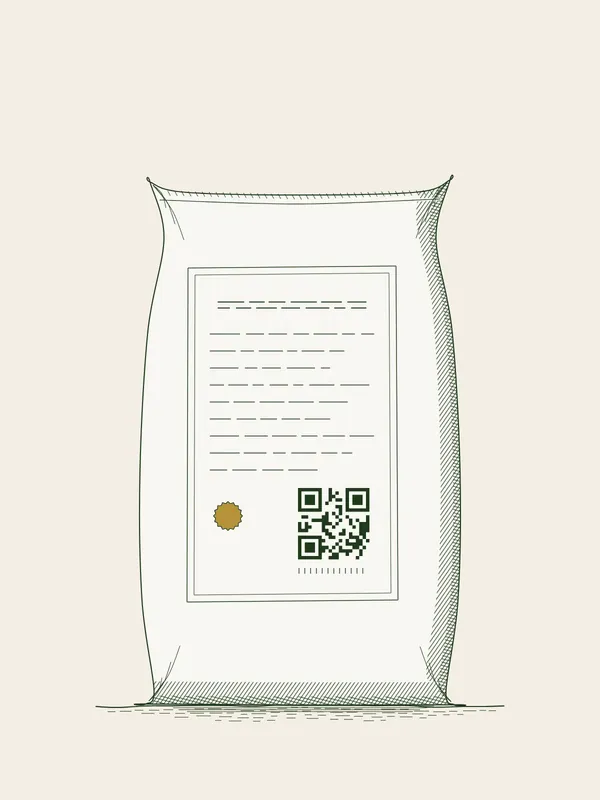
In Punjab, section 23 lists nine details: brand name; category; PS or reference number; licence number; composition; net weight; the manufacturer's or importer's name and address; the distributor's name and address; and the batch number with its date. Section 24 adds a QR code with a readable code beside it on every bag or container, and a covert security feature that inspectors check with a handheld device.1
One caution. The code printed on urea bags today is the FBR's federal tax track-and-trace, live across the industry since 1 Jul 2022; it is not Punjab's anti-fake QR.4 On 21 Oct 2026 we found no live Punjab system for checking a pack's QR. Our read-the-pack section shows where the nine details sit.
How does the Punjab Act grade bad fertilizer?
By nutrient strength against the approved limit. In Punjab, product at 70% to 95% of that limit is substandard, 30% to 69.9% is adulterated, and under 30% is fake, as is product that fails its non-chemical parameters.1
In Punjab, an official who samples splits it into three sealed portions: one to a Government Fertilizer Testing Laboratory, one to the Provincial Reference Fertilizer Testing Laboratory, and one to the person sampled. A party may appeal a result within 30 days. Substandard results lead to action after re-analysis; for adulterated or fake results, the Act says an FIR "shall be lodged abruptly".1 The Punjab Act has no clause letting a buyer ask for a test, unlike the Sindh, Khyber Pakhtunkhwa and Balochistan laws.3
What are the penalties under the Punjab Act?
| Offence in Punjab | First offence | Later offences |
|---|---|---|
| Fake or unlicensed fertilizer | 2 to 4 years and Rs 1 to 2 million | 2 to 5 years and Rs 2 to 4 million; then 3 to 7 years and cancellation |
| Adulterated fertilizer | 1 to 3 years and Rs 0.5 to 1.5 million | 2 to 6 years and Rs 1 to 3 million; then 3 to 6 years and cancellation |
| Substandard fertilizer | Rs 0.5 to 1 million fine | Rs 1 to 2 million within three years; then cancellation |
| Mislabelled or misbranded | Rs 1 to 2 million fine | The same fine and cancellation |
| Selling or storing without a dealer licence | Up to 6 months, Rs 100,000 to 500,000, or both | No separate scale |
| Expired product, or above the marked price | Up to 6 months, Rs 0.5 to 1 million, or both | No separate scale |
| Underweight packs | Up to 6 months, Rs 100,000 to 500,000, or both | No separate scale |
Source: Punjab Fertilizers Control Act 2025, section 36. Read 21 Oct 2026.
Holding a pack you are not sure of? Send us a clear photo of its label on WhatsApp.
Send a photoWhat is not published yet?
A good deal. In Punjab, the Act leaves fees, forms and many procedures to rules "as may be prescribed" under section 42, and we found none published on 21 Oct 2026. The Agriculture Department's forms page carried no dealer licence form that day.15 The Department must set up the section 18 track-and-trace system; until then, the Act says stock information "shall be shared manually".1
What should farmers and dealers check?
- Farmers: the nine details on the pack, the QR code with its readable code, and a receipt with your full address for every purchase. Products like zinc sulphate and BOP fall under the same rules.
- Dealers: a valid licence from your district Deputy Controller, declared godowns, the district price list on display, and sale and purchase records.
- Both: whether rules under section 42 have appeared, since they will set the fees and forms.
Questions farmers ask
Is the 1973 Fertilizer Control Order still in force?
No. Section 46 of the Punjab Act repealed it. Notifications issued under it continue only so far as they are consistent with the Act.
Does the Act cover humic acid?
Yes. In Punjab, the Act names humic acids among bio-stimulants, and its definition of fertilizer includes bio-stimulants.
Can a farmer in Punjab ask for a bag to be tested?
The Punjab Act has no clause for a buyer's request. Testing runs through official sampling. Sindh, Khyber Pakhtunkhwa and Balochistan laws do let a buyer apply.
Sources
- Punjab Fertilizers Control Act 2025 (Act XLIII of 2025), as published on the Punjab Code, sections 1 to 46. Checked 21 Oct 2026.
- Provincial Assembly of the Punjab, Bill No. 70 of 2025. Checked 21 Oct 2026.
- Government of Sindh, Sindh Fertilizer (Control) Act 1994, section 12; Khyber Pakhtunkhwa and Balochistan Fertilizer Control Acts, section 19. Checked 21 Oct 2026.
- ProPakistani, fertilizer makers on the FBR track-and-trace system, 2 Nov 2022. Checked 21 Oct 2026.
- Punjab Agriculture Department, Download Forms. Checked 21 Oct 2026.
This is a summary of the law as published on 21 Oct 2026, not legal advice. Rules under the Act may add fees, forms and procedures; confirm with your district Agriculture (Extension) office.