Chelated zinc or zinc sulphate: which to use on Pakistani soil
Zn-EDTA and zinc sulphate side by side: the zinc in each, how each behaves in our limy soils, what each costs per kilogram of zinc, when a chelate earns its price, and what Punjab's product list allows.

Rafiq Ali ShahidFounder, RS Granules
The short answer
For the soil dose at sowing, use zinc sulphate: Punjab's crop plans prescribe it, and it costs far less per kilogram of zinc. Chelated zinc (Zn-EDTA) earns its price in sprays and irrigation water. A standard reference rates synthetic chelates 2 to 5 times as available as zinc sulphate in soil, but about 5 to 10 times as expensive. In Punjab, Zn-EDTA at 5% is an active product category.
On this page 7 questions
What is the difference between chelated zinc and zinc sulphate?
Zinc sulphate is a salt. It is sold as the monohydrate, about 33% zinc, or the heptahydrate, about 21% zinc, and it can go on the soil or the leaves.2 Zn-EDTA holds its zinc in a chelate, EDTA in Punjab's product category, and a stable chelate keeps calcium from taking the zinc's place.15 That stability lets it mix with concentrated fertilizer solutions for soil and fertigation, and it can be sprayed.1
How do chelated zinc and zinc sulphate compare?
| What you get | Zinc sulphate | Zn-EDTA chelate |
|---|---|---|
| Zinc content | About 33% or 21%; the plans also list 27% | 5% solid or 6% liquid in Punjab's categories |
| In Punjab's crop plans | The soil dose: 6 kg of 33% an acre on wheat | Not in the dose lines |
| In alkaline soil | Added zinc fixed quickly in a Multan study | 2 to 5 times as available |
| As a spray | Acidic; better with some lime | Suited; low zinc, so a bad shortage may need repeat sprays |
| In fertigation | Not covered by these sources | Suited: stable in concentrated solutions |
| Price per kg of zinc | Lower | About 5 to 10 times as much |
Sources: Alloway 2008, page 83; FAO 2006, chapter 5; Rafique and others 2011; Punjab wheat plan 2026-27, page 15; SFRI product list.
Which one stays available in alkaline soil?
Most of our crop land is calcareous, with free lime holding the pH between 7.5 and 8.4, and those conditions restrict the zinc a crop can take up.6 In a five-year study near Multan, soils kept testing short of zinc even where zinc had been added every year; the authors conclude that added zinc is quickly fixed into forms the crop cannot use.3
That is where a chelate earns its keep. Disodium zinc EDTA is stable enough that calcium is unlikely to take the zinc's place, in the soil or in a concentrated solution.1 The same reference puts synthetic chelates at 2 to 5 times as available as zinc sulphate when applied to soil.1
What does each cost per kilogram of zinc?
We have no current Pakistani prices on file, so work it out from your dealer's quotes. Divide the price by the zinc in the pack. A 2 kg pack of Zn-EDTA at 5% holds 100 g of zinc; 6 kg of zinc sulphate 33% holds about 2 kg.
The reference puts chelates at about 5 to 10 times the price of zinc sulphate, against 2 to 5 times the availability in soil.1 For the full soil dose that sum favours zinc sulphate, and the plans write their doses in it.4 Our zinc sulphate per acre guide gives those doses crop by crop.
When does a zinc chelate pay its way?
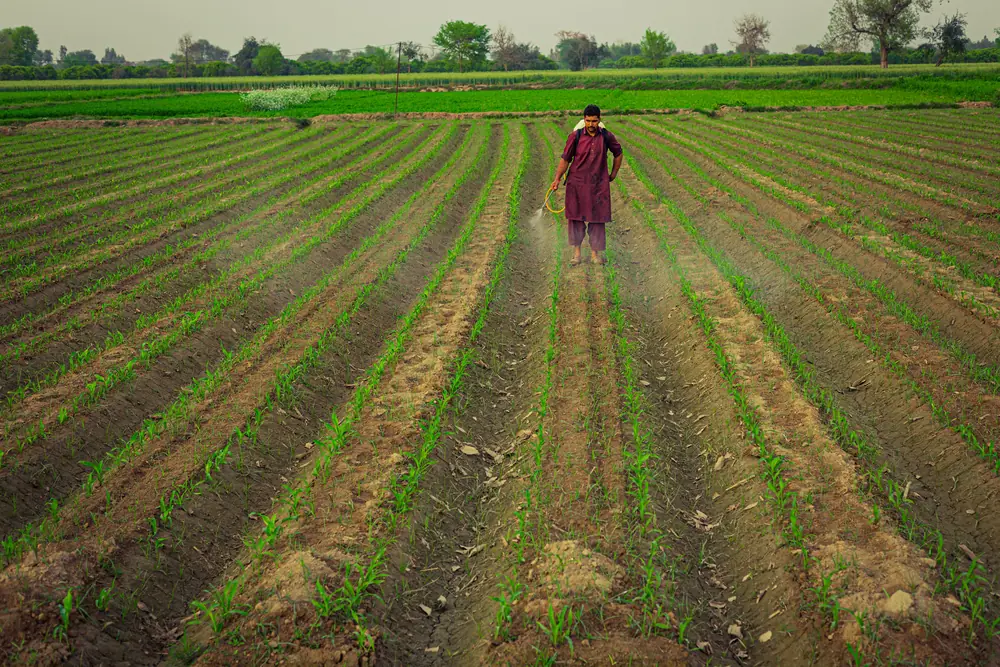
- Sprays on a standing crop. Zinc sulphate is acidic on the leaf; FAO prefers it with some lime, or a chelate such as Zn-EDTA, for sprays.2 The Punjab wheat plan's own booting spray, for a crop that missed zinc at sowing, uses zinc sulphate 33% at 350 g in 100 litres of water an acre.4
- Drip and fertigation. Stable chelates suit mixing into concentrated fertilizer solutions.1
- Grain zinc. In a global review of 15 wheat studies, zinc sprays of any form raised grain zinc by a median 63% against 19% for soil-applied zinc. Those were not Pakistani trials.6
A chelate's low zinc content means a bad shortage may need repeat sprays.1 For the soil dose at sowing, stay with the plan's zinc sulphate, as our wheat fertilizer plan sets out.
Weighing a chelate against zinc sulphate for your crop? Send us your crop, acres and soil report on WhatsApp.
Ask which fitsWhat do Punjab's product categories say about zinc chelates?
Punjab's Soil Fertility Research Institute lists 33 active and 25 suspended product categories. Zn-EDTA (5%) and Zinc Liquid Chelated (6%) are active. Most chelated iron, manganese and copper products are suspended, as are Boron Chelated Liquid (2%) and Multi-micronutrient Chelated Liquid 6%.5
On the pack, check the category and the composition. Under the Punjab Fertilizers Control Act 2025, both are among the nine details every pack must carry, beside the licence number and the batch number with its date.7 Our read-the-pack section shows where they sit.
From RS Granules
Chelated Zinc 5%
Zn-EDTA powder: zinc held in an EDTA chelate so it stays available to the plant. Dissolve it for a spray or the irrigation water. Follow the label on the pack.
Questions farmers ask
Is chelated zinc better than zinc sulphate?
In alkaline soil it stays more available, at a much higher price per kilogram of zinc. For the soil dose at sowing, Punjab's crop plans name zinc sulphate; chelates suit sprays and irrigation water.
Can I spray zinc sulphate?
Yes, at a low strength. The wheat plan's booting spray uses 350 g of zinc sulphate 33% in 100 litres of water an acre. FAO notes it is acidic and prefers it with some lime, or a chelate, for sprays.
Is a liquid zinc chelate allowed in Punjab?
Zinc Liquid Chelated (6%) is an active category on SFRI's product list, beside the 5% Zn-EDTA solid. Check the category on the pack matches one of them.
Sources
- Alloway B.J., Zinc in Soils and Crop Nutrition, 2nd edition, IZA and IFA, 2008, page 83. Checked 21 Oct 2026.
- FAO, Plant Nutrition for Food Security, Fertilizer and Plant Nutrition Bulletin 16, 2006, chapter 5. Checked 21 Oct 2026.
- Rafique E., Rashid A. and Mahmood-ul-Hassan M., apparent zinc balances in irrigated cotton-wheat Aridisols, Zinc Crops 2011. Checked 21 Oct 2026.
- Punjab Agriculture Department, Production Plan Wheat 2026-27 (Urdu), pages 15 and 16. Checked 21 Oct 2026.
- Soil Fertility Research Institute, Punjab, Active and Suspended Product List. Checked 21 Oct 2026.
- Joy E.J.M. and others, a study of zinc fertilizer use on wheat in Pakistan, Plant and Soil 411, 2017, pages 139 to 150. Checked 21 Oct 2026.
- Punjab Fertilizers Control Act 2025 (Act XLIII of 2025), section 23. Checked 21 Oct 2026.
General guidance from published references and the Punjab Agriculture Department's plans. Follow the label on any product you use, and ask your district Agriculture Extension office when in doubt.